The Renewable Energy Transition: A New Geopolitical Game
Abstract
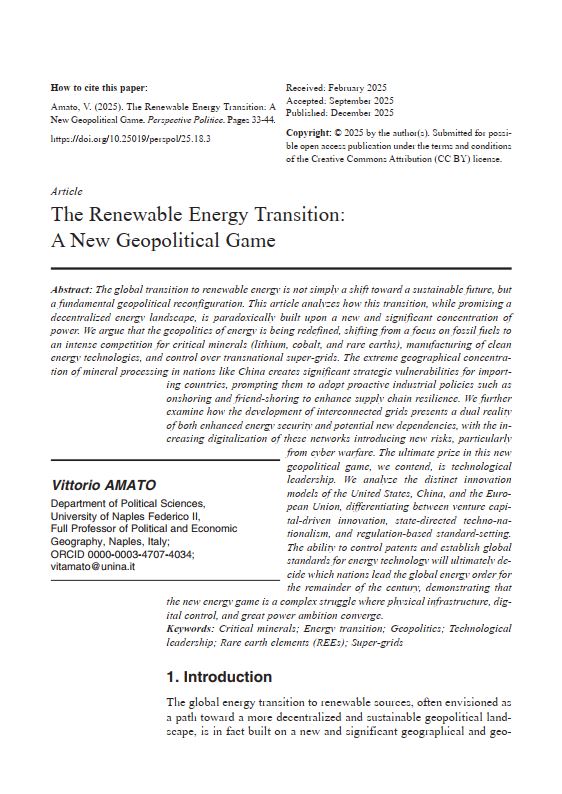
The global transition to renewable energy is not simply a shift toward a sustainable future, but a fundamental geopolitical reconfiguration. This article analyzes how this transition, while promising a decentralized energy landscape, is paradoxically built upon a new and significant concentration of power. We argue that the geopolitics of energy is being redefined, shifting from a focus on fossil fuels to an intense competition for critical minerals (lithium, cobalt, and rare earths), manufacturing of clean energy technologies, and control over transnational super-grids. The extreme geographical concentration of mineral processing in nations like China creates significant strategic vulnerabilities for importing countries, prompting them to adopt proactive industrial policies such as onshoring and friend-shoring to enhance supply chain resilience. We further examine how the development of interconnected grids presents a dual reality of both enhanced energy security and potential new dependencies, with the increasing digitalization of these networks introducing new risks, particularly from cyber warfare. The ultimate prize in this new geopolitical game, we contend, is technological leadership. We analyze the distinct innovation models of the United States, China, and the European Union, differentiating between venture capital-driven innovation, state-directed techno-nationalism, and regulation-based standard-setting. The ability to control patents and establish global standards for energy technology will ultimately decide which nations lead the global energy order for the remainder of the century, demonstrating that the new energy game is a complex struggle where physical infrastructure, digital control, and great power ambition converge.
Downloads
Published
Issue
Section
License
Copyright (c) 2025 Vittorio AMATO

This work is licensed under a Creative Commons Attribution-NonCommercial-ShareAlike 4.0 International License.