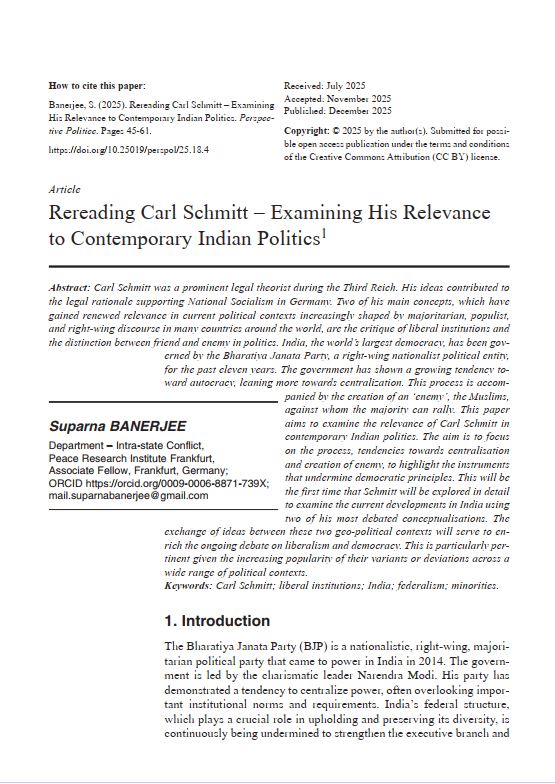
Rereading Carl Schmitt – Examining His Relevance to Contemporary Indian Politics
Abstract
Carl Schmitt was a prominent legal theorist during the Third Reich. His ideas contributed to the legal rationale supporting National Socialism in Germany. Two of his main concepts, which have gained renewed relevance in current political contexts increasingly shaped by majoritarian, populist, and right-wing discourse in many countries around the world, are the critique of liberal institutions and the distinction between friend and enemy in politics. India, the world’s largest democracy, has been governed by the Bharatiya Janata Party, a right-wing nationalist political entity, for the past eleven years. The government has shown a growing tendency toward autocracy, leaning more towards centralization. This process is accompanied by the creation of an ‘enemy’, the Muslims, against whom the majority can rally. This paper aims to examine the relevance of Carl Schmitt in contemporary Indian politics. The aim is to focus on the process, tendencies towards centralisation and creation of enemy, to highlight the instruments that undermine democratic principles. This will be the first time that Schmitt will be explored in detail to examine the current developments in India using two of his most debated conceptualisations. The exchange of ideas between these two geo-political contexts will serve to enrich the ongoing debate on liberalism and democracy. This is particularly pertinent given the increasing popularity of their variants or deviations across a wide range of political contexts.
Downloads
Published
Issue
Section
License
Copyright (c) 2025 Suparna BANERJEE

This work is licensed under a Creative Commons Attribution-NonCommercial-ShareAlike 4.0 International License.