The Transformations of the Romanian Leadership in 1965: Between Continuity and Change
Abstract
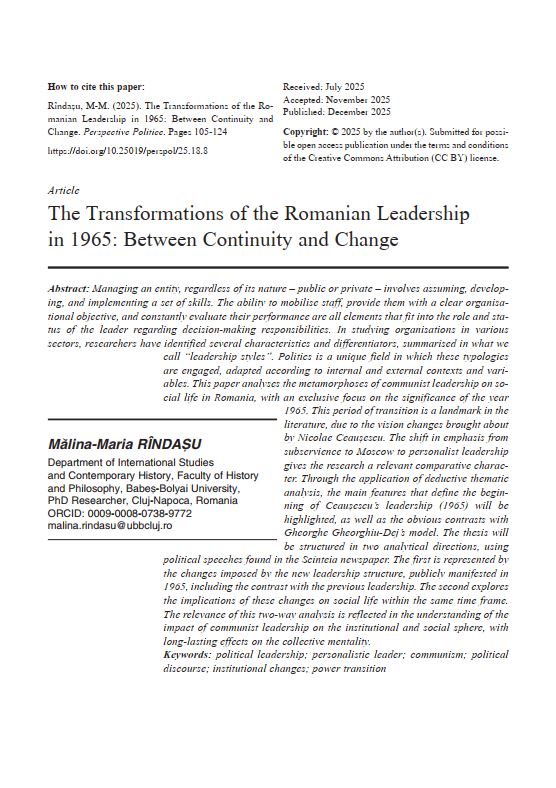
Managing an entity, regardless of its nature – public or private – involves assuming, developing, and implementing a set of skills. The ability to mobilise staff, provide them with a clear organisational objective, and constantly evaluate their performance are all elements that fit into the role and status of the leader regarding decision-making responsibilities. In studying organisations in various sectors, researchers have identified several characteristics and differentiators, summarised in what we call “leadership styles”. Politics is a unique field in which these typologies are engaged, adapted according to internal and external contexts and variables. This paper analyses the metamorphoses of communist leadership on social life in Romania, with an exclusive focus on the significance of the year 1965. This period of transition is a landmark in the literature, due to the vision changes brought about by Nicolae Ceauºescu. The shift in emphasis from subservience to Moscow to personalist leadership gives the research a relevant comparative character. Through the application of deductive thematic analysis, the main features that define the beginning of Ceauºescu’s leadership (1965) will be highlighted, as well as the obvious contrasts with Gheorghe Gheorghiu-Dej’s model. The thesis will be structured in two analytical directions, using political speeches found in the Scînteia newspaper. The first is represented by the changes imposed by the new leadership structure, publicly manifested in 1965, including the contrast with the previous leadership. The second explores the implications of these changes on social life within the same time frame. The relevance of this two-way analysis is reflected in the understanding of the impact of communist leadership on the institutional and social sphere, with long-lasting effects on the collective mentality.
Downloads
Published
Issue
Section
License
Copyright (c) 2025 Malina-Maria RINDASU

This work is licensed under a Creative Commons Attribution-NonCommercial-ShareAlike 4.0 International License.